Factoring as a Service (FaaS)

Your factoring company, automated

You run the operations and bring in new clients inside the Capitalis CRM, and everything else is automated and handled by the Capitalis system. All on a flat monthly subscription, with no percentage of the invoice.

What is FaaS

The operation is yours.
The platform is ours.

You do two things: run the operations and bring in new clients, both inside Capitalis. Everything else the system does on its own. In the Factoring as a Service model, the party that buys the receivable, carries the credit risk and answers to the regulator is still your factoring company, as it has always been. What becomes a service is the work, for a flat monthly subscription. No percentage on the invoice and no share of what you earn.

  • Document signing, built in. Factoring agreements, assignment terms and addenda signed inside the platform itself, recording who signed, when and from where. The signed document is kept in a sealed archive on your side, not only at the provider.
  • Bank consolidation. Accounts connected through Open Finance come in by themselves, and reconciliation matches every statement line to its entry. Whatever does not match stays visible as a difference to explain, instead of disappearing into a total that balances by accident.
  • Automatic settlement of invoices. When the bank confirms payment — Pix, boleto or return file — the invoice is written off on its own, the amount is split across the invoices it covers, and the operation closes once none are left open. Nobody settles it by hand.
  • Automated collections. The dunning schedule fires over WhatsApp, SMS, e-mail and phone on the days you set, and escalates to credit bureau listing and protest without anyone having to remember.
  • Built-in credit analysis. Credit bureau lookups inside the client and debtor record, with credit checks applied at the moment you approve the batch.
  • Connection to the rest of your stack. REST API and MCP server for your own systems and for AI assistants, plus ERP and accounting integration.

Stage, plainlyThe foundation of all this is built, tested and running in a staging environment. The third-party connections, bank, credit bureau, e-signature, notary and receivables registrar, run in test mode today and only go live with each provider's contract and credentials. This page describes how each piece was designed to work, not a client already operating on it.

Who does what
Responsibility
Your factoring firm
Buys the receivable, carries the credit risk, registers the invoice, reports to COAF (Brazil's financial intelligence unit) and answers legally for the data of its clients and debtors. That is what the data protection law calls the controller.
Capitalis
Operates the platform and holds the data on your instructions, which is what the law calls the processor. Delivers the operational and compliance tooling, and charges a monthly subscription, never a percentage of the amounts moved.
Legacy setup

Spreadsheets, email and software nobody audits.

The record of what happened depends on someone remembering to write it down. When the client asks, the answer is a reconstruction, not a proof.

Capitalis

A record nothing erases, and anyone can check.

Entries are never rewritten. A mistake is corrected with a reversal, a new line that cancels the previous one. Every action gets a tracking number, and that number ties the system log, the audit trail and the books together. A single search reconstructs everything that happened.

technical nameimmutable ledger · append-only trail · end-to-end request_id
Layer 1

Operate

The invoice batch closes on screen, from the maths to the payout. Discount, taxes and fees come out ready, approval follows the authority level of each amount band, and the payout is recorded. Every invoice is born with an owner, an origin and a trail.

  • Deals and new deal
  • Clients, debtors and credit files
  • Trustee with segregated funds
  • Debtor confirmation before payout
Layer 2

Automate

From here the platform works on its own. The bank statement comes in through the banking connection and reconciliation matches every line against its entry, with nobody typing. The month result builds itself from your own entries. The collection cadence fires under the rules you configured, and Capitão IA answers about your portfolio reading only your own firm's data, within what the person asking is allowed to see.

  • Automatic bank reconciliation through Open Finance
  • Entries and month result built on their own
  • Collections fired by your rules, with no operator
  • Capitão IA answering on your own data
Layer 3

Collect

The cadence chases while your team operates. Automated messages on each channel, a dialing queue with the phone inside the browser and, when the cadence runs out, credit-bureau listing and notary protest.

  • Reminders by several channels, with monitoring
  • In-browser dialer with sealed recordings
  • Credit-bureau listing (Pefin)
  • Notary protest via CENPROT
Layer 4

Prove

You don't have to trust the platform. You can check it. Every action that touches money or sensitive data leaves a complete trail, one nobody can alter afterwards and that links end to end, from the click down to the cent.

  • A record that only takes new lines, never edits
  • A sealed copy outside the system, stamped against tampering
  • One tracking number tying everything together
  • Mistakes corrected by reversal, never by deletion
technical nametrustless by design · append-only · WORM with hash chaining · request_id
Platform

Everything a factoring company needs, in 12 modules.

From lead capture to the accounting export, every module is born with your firm data isolated inside the database itself and with a record of everything that was done. Twelve modules and, inside them, two screens that earn a card of their own, e-signatures in Deals and Pix and bank slips in Integrations.

Overview

Dashboard.

Your portfolio's financial picture on one screen, computed live.
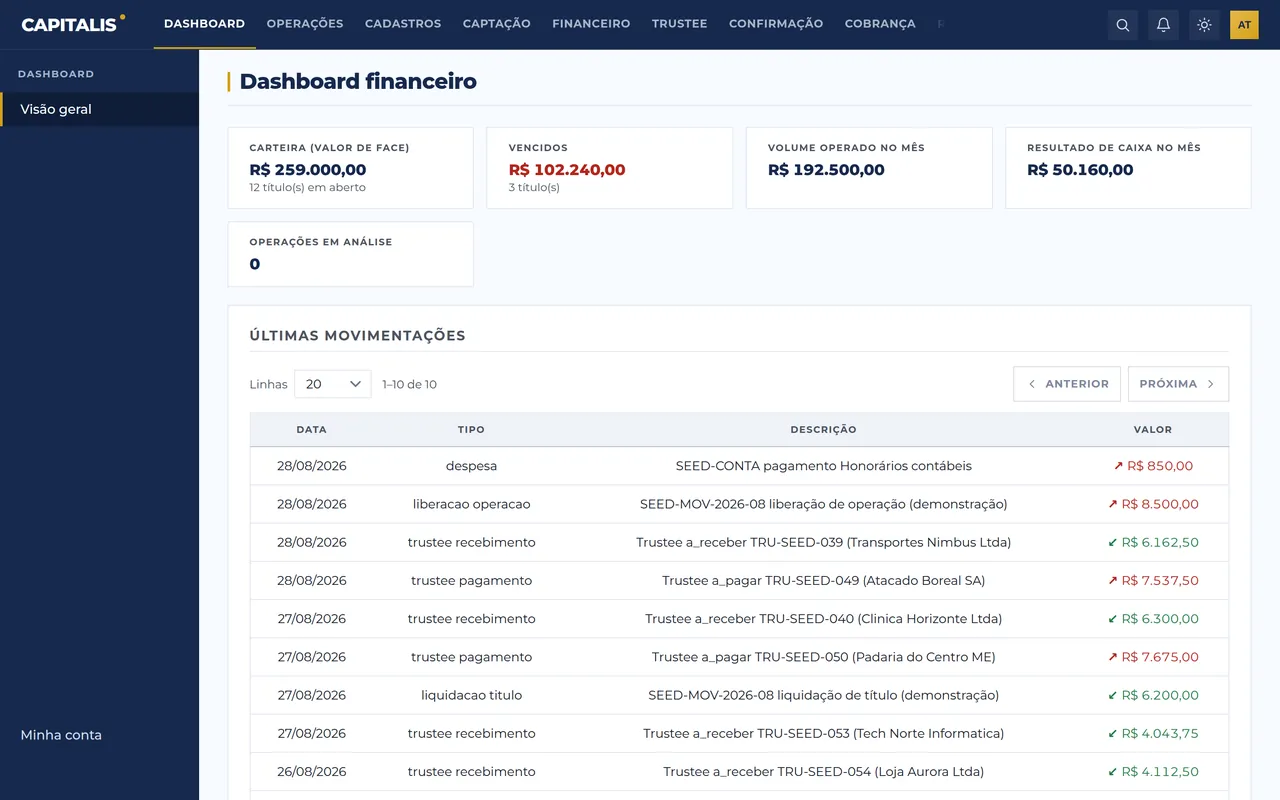
Real Dashboard screen of the Capitalis platform, with demonstration data.DashboardOpen balance, overdue and the month result, computed live over your portfolio.Enlarge
Core

Deals.

The heart of the operation. Invoice batches with discount, taxes and fees, approval and disbursement.
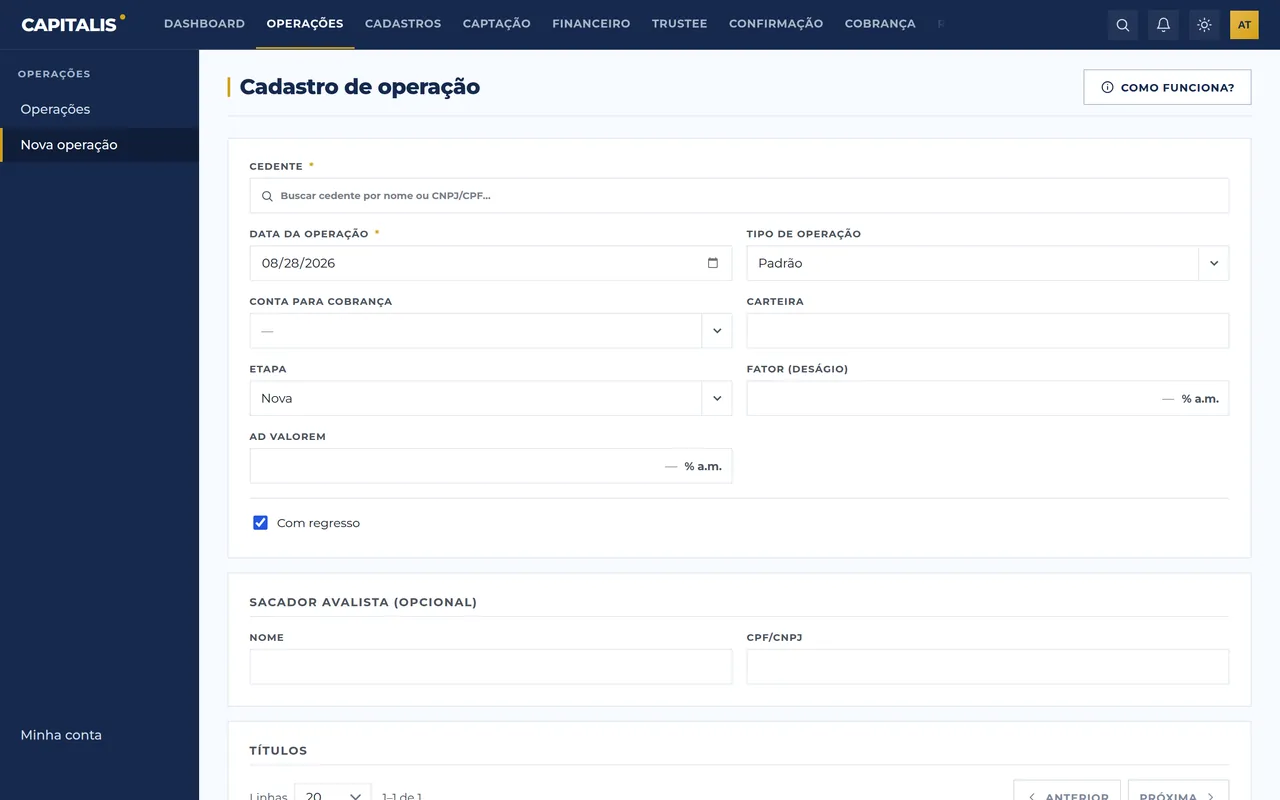
Real New deal screen of the Capitalis platform, with demonstration data.New dealThe batch receivables with discount, tax and fees computed, approval by authority level and a recorded payout.Enlarge
Foundation

Registry.

Clients and debtors with economic groups, risk classes, credit files and witnesses.
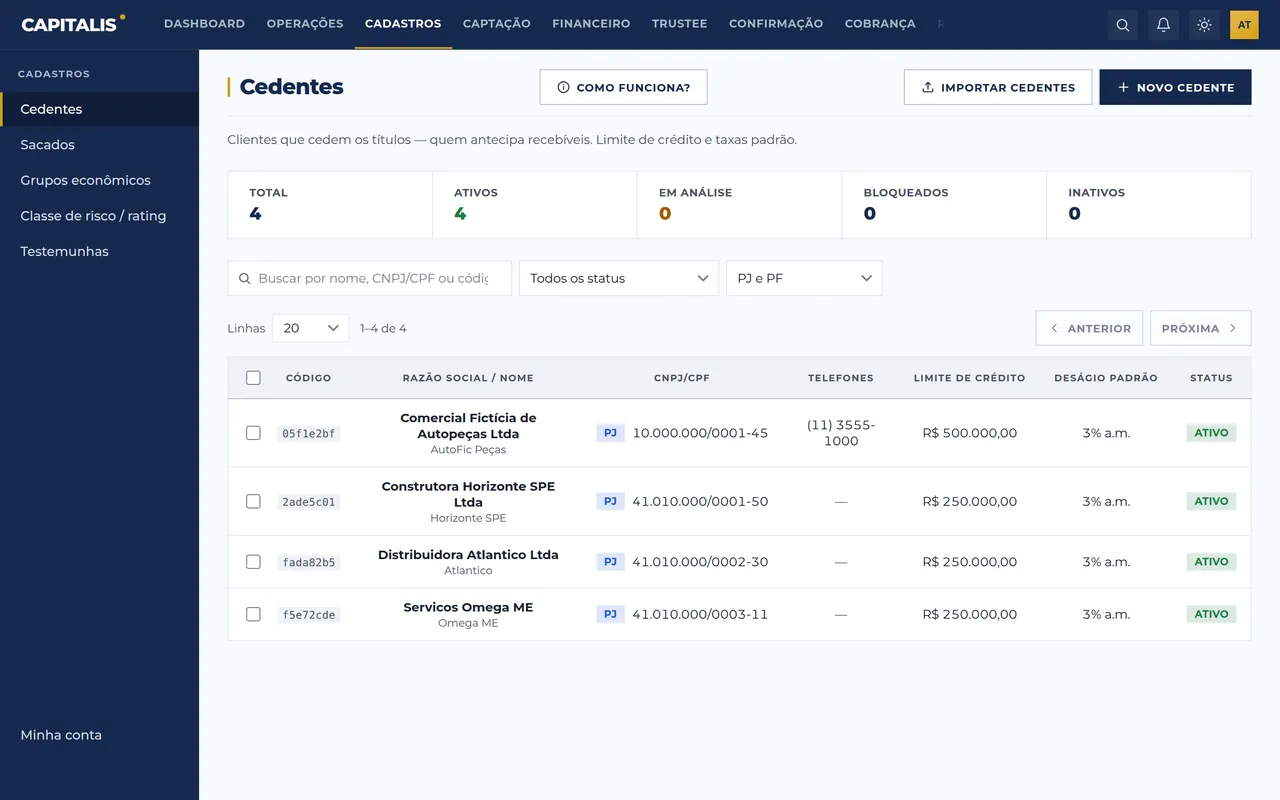
Real Client record screen of the Capitalis platform, with demonstration data.Client recordThe list on the left, the full record on the right, with economic group, risk class and limit.Enlarge
Sales

Lead capture.

A kanban marketing funnel and campaigns to bring in new clients.
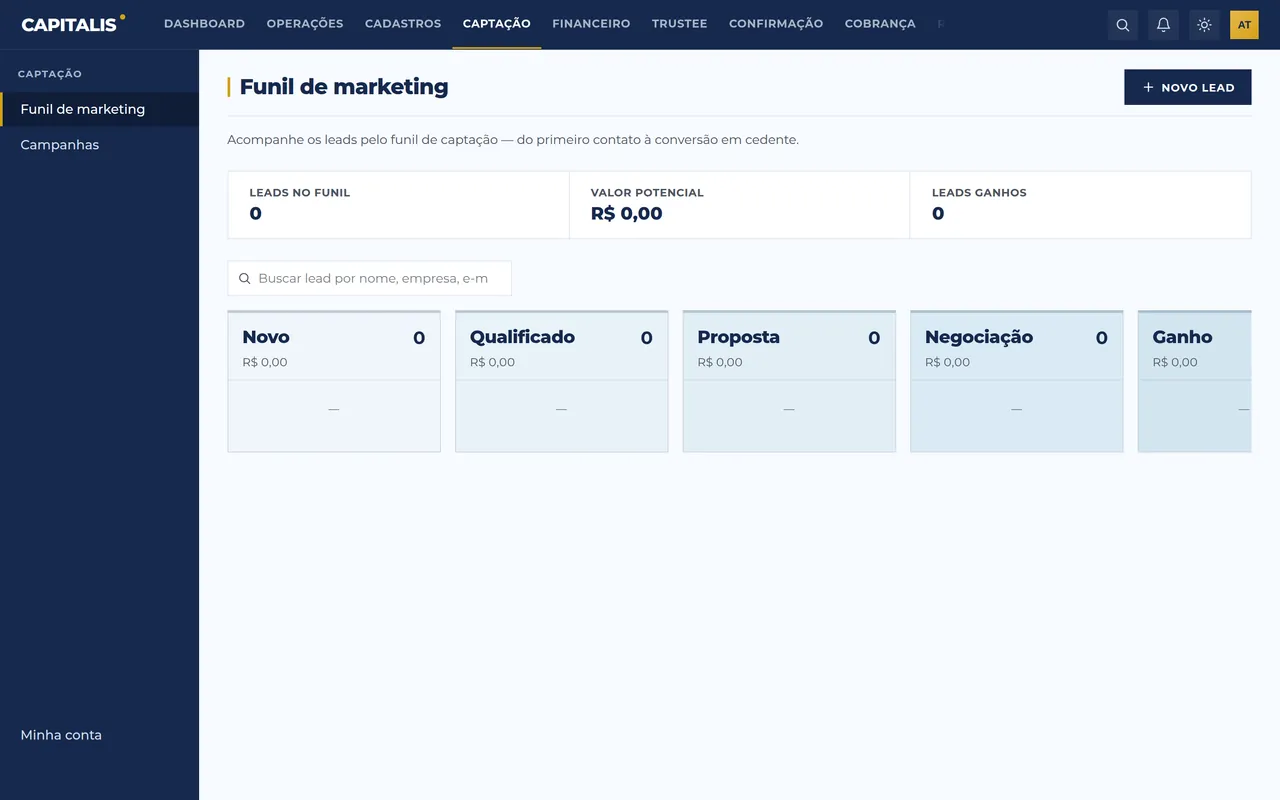
Real Kanban funnel screen of the Capitalis platform, with demonstration data.Kanban funnelThe lead moving across columns until it becomes a registered client.Enlarge
Management

Finance.

Entries, cash flow, payables, bank reconciliation, bank exchange files and the month result.
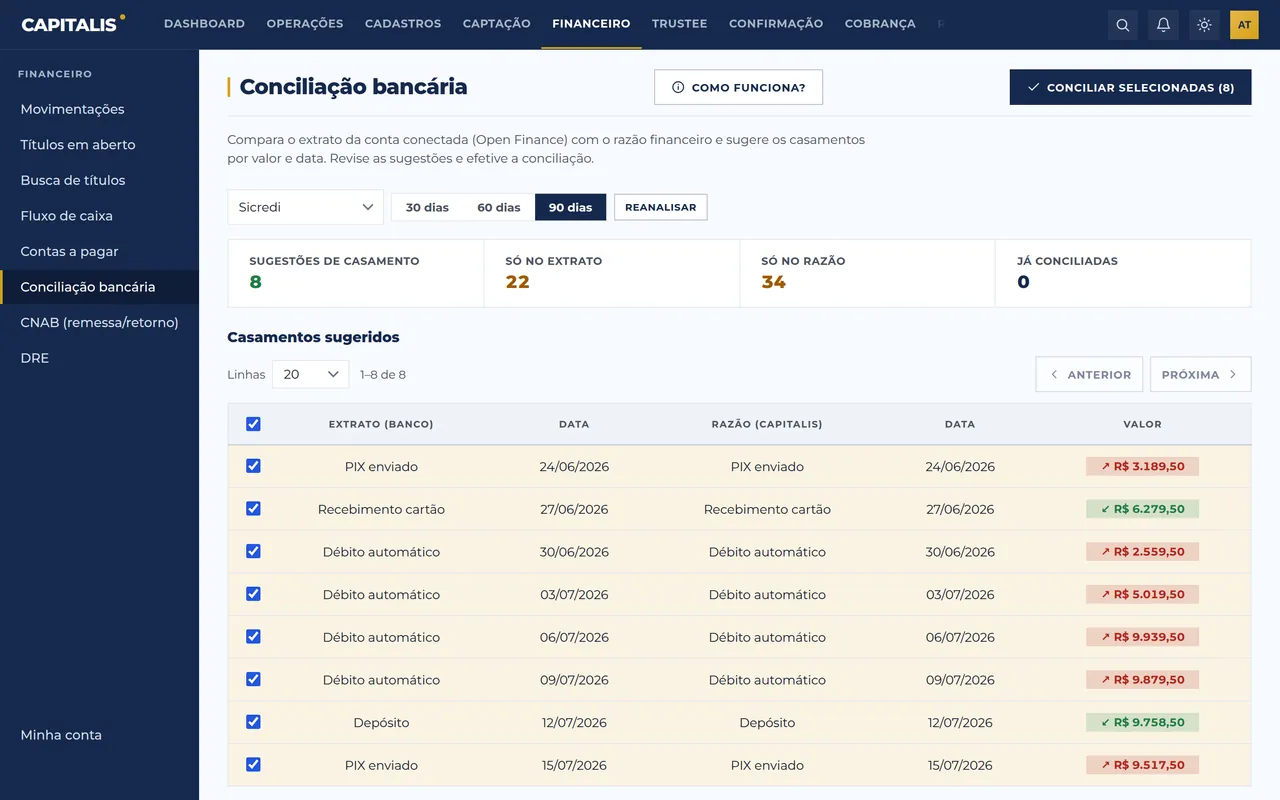
Real Bank reconciliation screen of the Capitalis platform, with demonstration data.Bank reconciliationThe bank statement on one side, your own entries on the other, matched lines in gold. What does not match stays visible.Enlarge
Outsourcing

Trustee.

Managing receivables and payables on the client's behalf, with segregated funds.
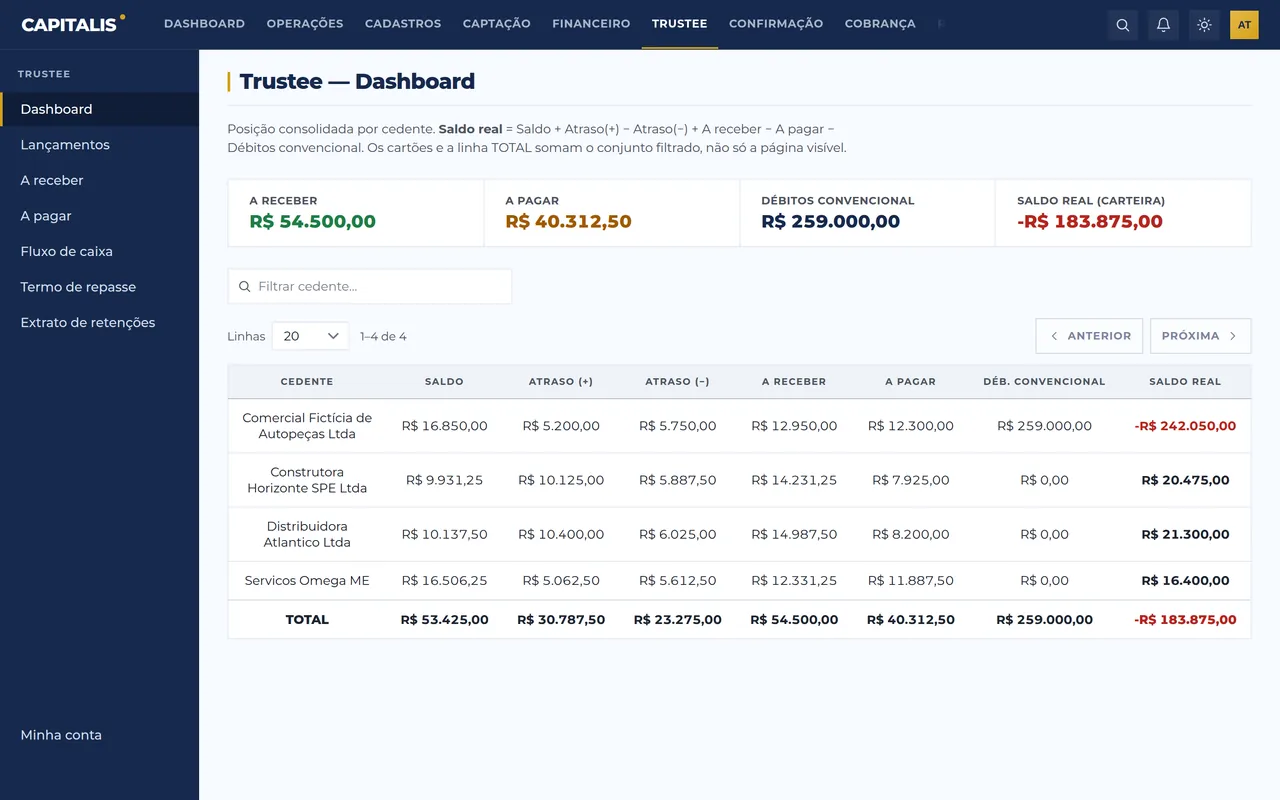
Real Trustee screen of the Capitalis platform, with demonstration data.TrusteeThe client's money in a segregated account, with receivables and payables managed on their behalf.Enlarge
Anti-fraud

Confirmation.

Debtor verification before any payout, a defense against fake invoices, with the call recorded and sealed.
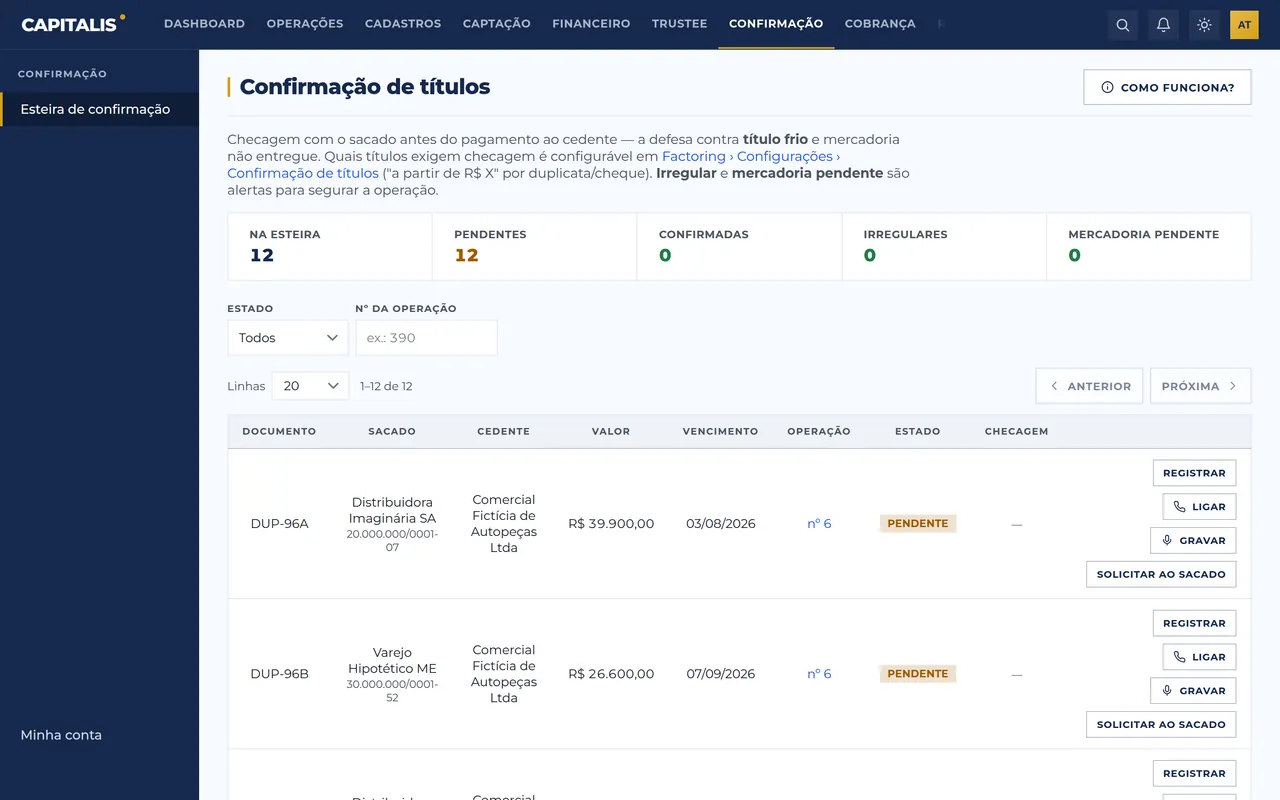
Real Confirmation call screen of the Capitalis platform, with demonstration data.Confirmation callThe call with the debtor recorded inside the screen, sealed so any change to the audio shows, and stored securely inside Capitalis itself.Enlarge
Recovery

Collections.

Reminders by several channels, calls from the browser, credit-bureau listing and notary protest, all inside the platform.
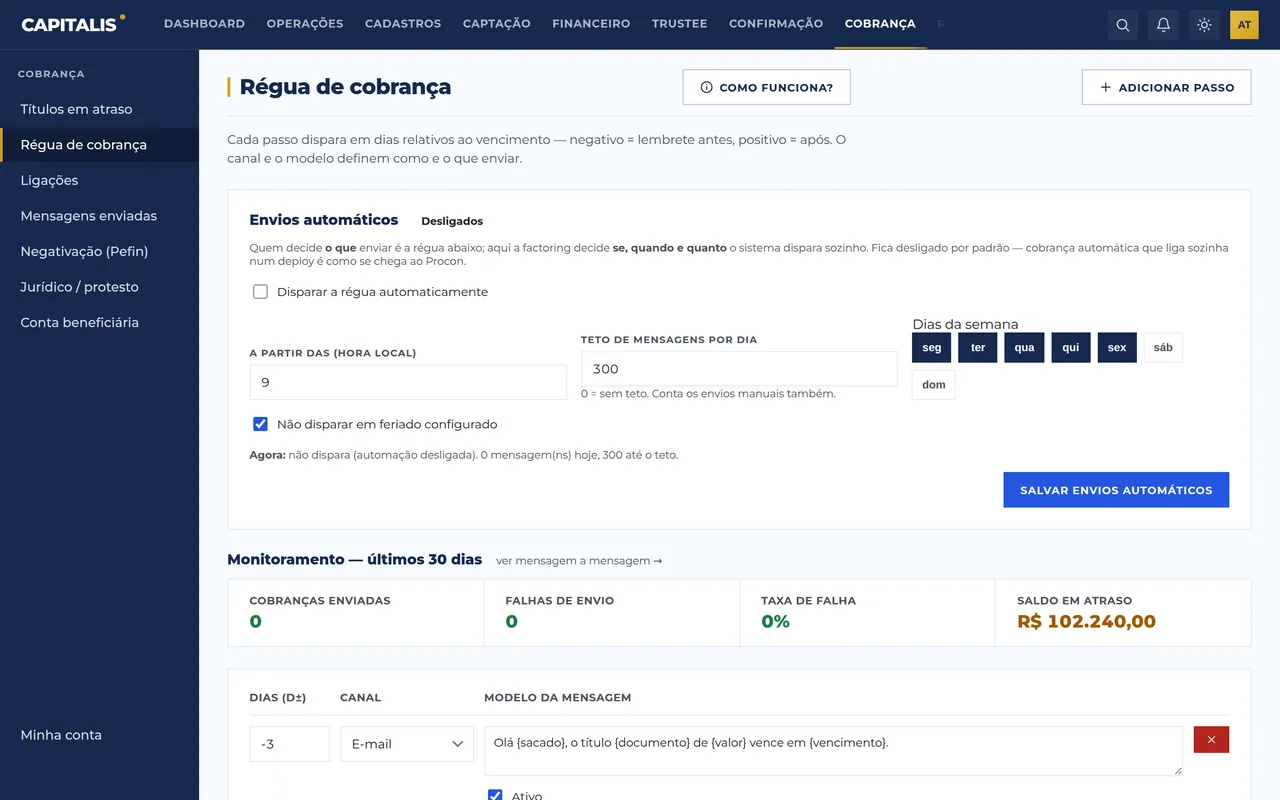
Real Dunning ladder screen of the Capitalis platform, with demonstration data.Collection cadenceThe steps in days relative to the due date and the escalation to bureau listing and notary protest.Enlarge
Insight

Reports.

Portfolio, revenue, performance, concentration, taxes and accounting export.
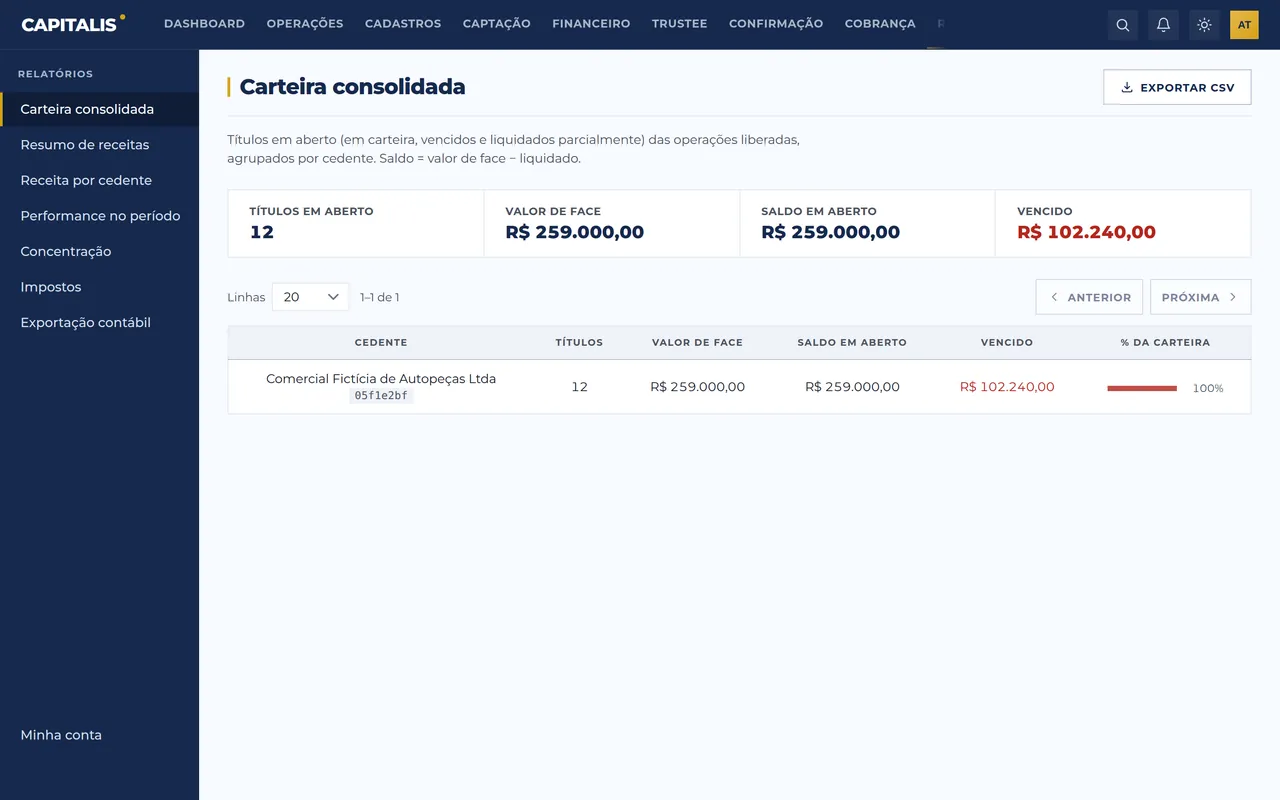
Real Reports screen of the Capitalis platform, with demonstration data.ReportsPortfolio, revenue, performance and concentration, with CSV export.Enlarge
AI

Captain AI.

Ask the way you would say it out loud, right in the platform.
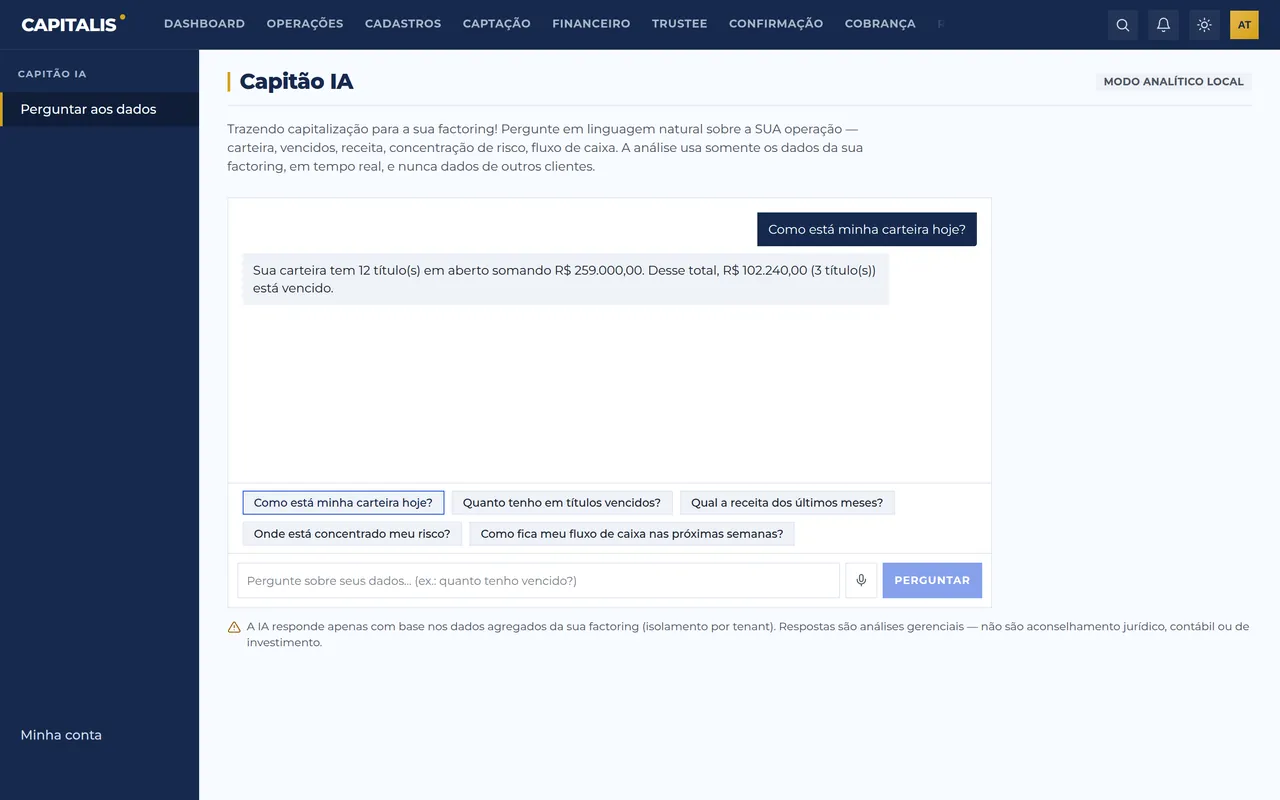
Real Capitão IA screen of the Capitalis platform, with demonstration data.Capitão IAThe question in plain language and the answer coming from your own data, with the option to dictate it.Enlarge
Inside Deals

E-signatures.

Electronic document signing, with a record of who signed, when and from where.
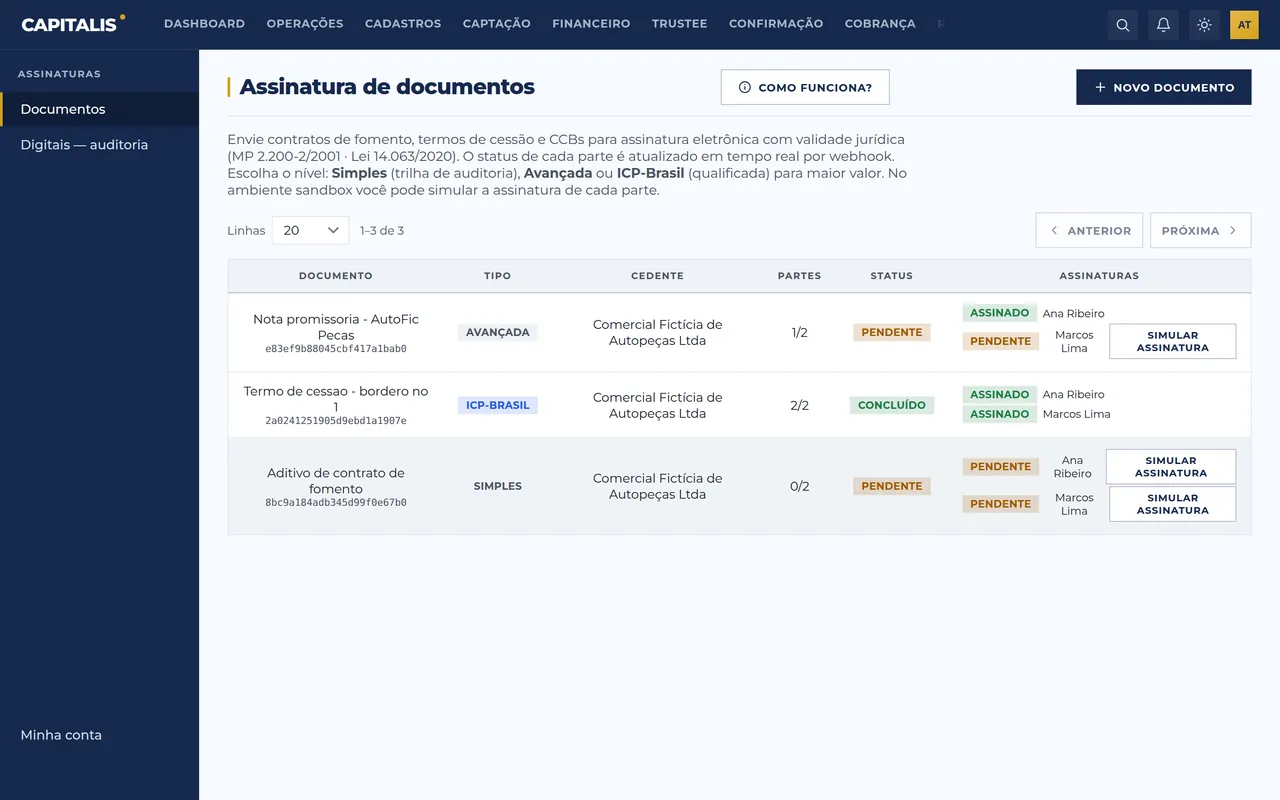
Real Signatures screen of the Capitalis platform, with demonstration data.SignaturesThe document on one side, per-party status on the other, until the package closes.Enlarge
Ecosystem

Integrations.

Bank connection, escrow and Pix accounts, management and accounting software, Gmail, plus access for other systems and for AI assistants.
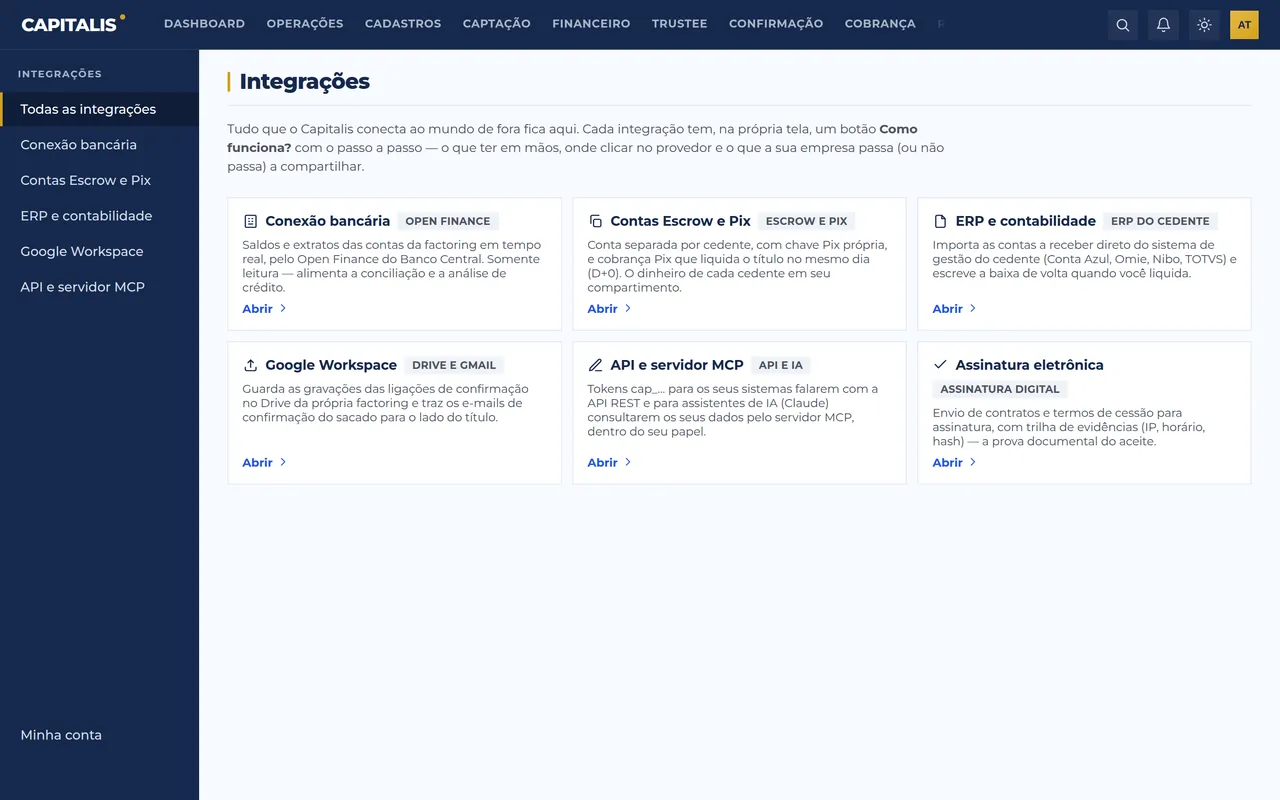
Real Integrations screen of the Capitalis platform, with demonstration data.IntegrationsBanking connection, escrow and Pix accounts, management software, Gmail, plus access for other systems and for AI assistants.Enlarge
Settings

Company.

Your firm's page. Credit policy, collection rules, fees, staff and COAF settings.
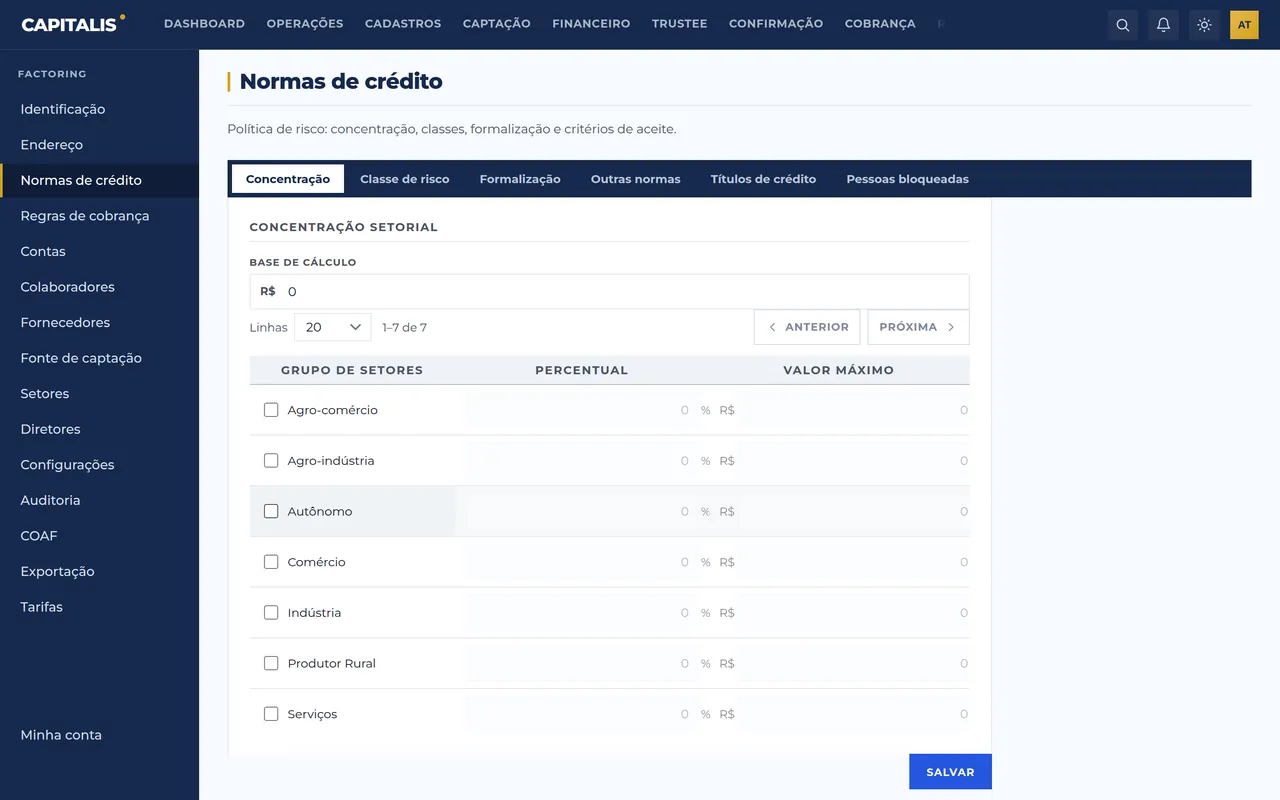
Real Factoring settings screen of the Capitalis platform, with demonstration data.Factoring settingsCredit policy, collection rules, fees, authority levels and money-laundering reporting, each behind its own switch.Enlarge
Inside Integrations

Pix & Bank slips.

Collections via Pix and registered bank slips at a flat fee per event, never a percentage of the invoice.
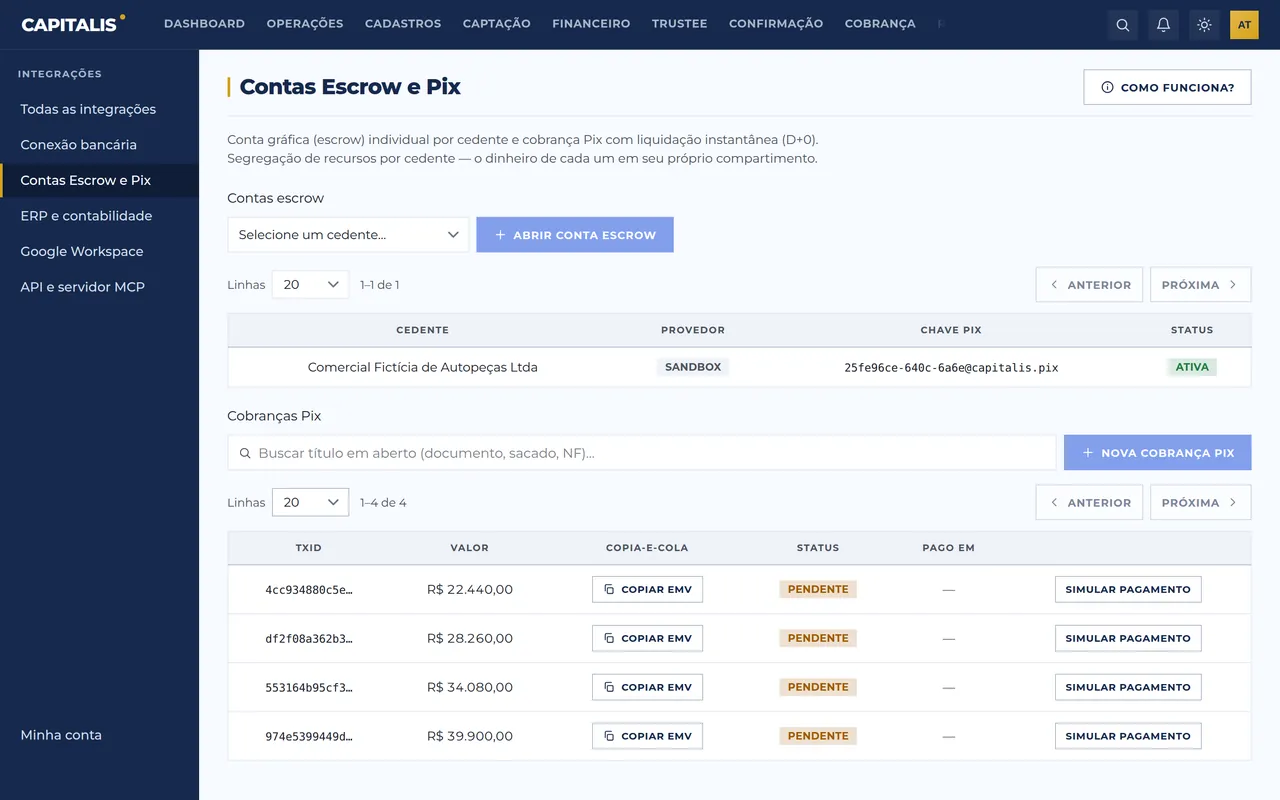
Real Pix and bank slips screen of the Capitalis platform, with demonstration data.Pix and bank slipsThe payment slip with barcode and the Pix QR code, crediting your firm's account.Enlarge
The tools up close

The manual work of a
factoring company, automated.

Six fronts carry the day of anyone running receivables finance. The foundation of each one is built and checked line by line. The integrations with banks, credit bureaus, notaries and the receivables registrar run in test and staging environments, and each one only goes live with the provider's contract and credentials.

Banking integration

The bank statement comes in by itself, already checked.

Your firm connects its accounts through Open Finance, the official scheme that lets a bank share your own data with whoever you authorise. From there Capitalis reads balances, inflows, outflows and every single transaction in real time. This is not a spreadsheet exported from internet banking at the end of the day. It is the bank's own position, inside the screen where you decide credit.

Reconciliation matches each statement line against its entry. What does not match stays visible as what it is, a difference to explain, instead of disappearing inside a total that happens to add up.

  • Read access, never movement. The Open Finance consent authorises reading balances and statements. The platform does not transfer, does not pay and does not take money out of your account, and the client revokes access whenever they want, in their own bank's app.
  • A credit card is not cash. The service that brings in the bank data returns the current account and the card in the same list, under the same label. On a card that number is the open bill, which is a debt. Adding it all up would make an R$ 8,000 debt show as a positive balance on a screen whose whole purpose is deciding credit. Each account carries its nature and totals are added up in separate groups.
  • An authorised purchase is not money that has left. Pending transactions go to a block of their own and stay out of the period cash.
  • Money in is money in, money out is money out. The platform standardises the sign of every amount, whatever convention each bank uses on its side. Without that fix, a card purchase would land in the analysis as revenue.
technical nameread-only Open Finance consent · current account and card in separate families · pending transactions kept out of period cash · sign normalisation stagefoundation built · bank connection in sandbox · homologation with the Open Finance provider before going live
Getting paid

The money lands straight in your firm's own account, by slip or by Pix.

The slip is issued from inside the invoice batch itself. You pick the receivables and Capitalis registers the charge with the partner issuing bank. The slip comes back with the real payment line, the one a teller and a banking app can actually read. The amount charged is the balance still outstanding, not the full face value. If the debtor already paid 1,500 of a 5,000 receivable, the slip comes out at 3,500.

Money never passes through Capitalis. What gets paid is your firm's own account inside the issuing bank, chosen on screen, and when it changes the platform asks for confirmation showing which account it is moving from and to. Slips and Pix credit that same account. The platform instructs the bank, it never holds your money.

  • A receivable is only settled once the bank confirms it. The payment notice arrives signed, and even signed it is treated as an alert, not as truth. Before settling anything, the platform asks the bank whether the money actually came in. A forged notice settles nothing.
  • One payment credits once. Three barriers hold a repeated notice. The platform recognises a notice it has already seen, locks the record while it updates, and refuses to settle what is already settled. The amount received is spread across the covered receivables, up to each one open balance. A receivable already cleared another way is not paid again.
  • Pix with a due date, single use or reusable. QR codes come from the same connection and credit the same account of your firm.
  • Cancelling means cancelling at the bank first. Only then does the slip show as cancelled here. Marking it cancelled without telling the bank would leave it still payable out there.
  • Flat fee per event, never a percentage. Ticket sizes in this industry are large. One percent of a 10,000 receivable is 100 on every settlement, which eats your firm margin. A provider that charges a percentage is ruled out here.
technical nameJWT RS256 signed on every call · webhook notice with HMAC-SHA256 · confirmation by authenticated query · deduplication, row lock and status guard stagefoundation built · slips and Pix in sandbox · in homologation with the issuing bank (Luri), no real charge issued yet
Automated collections

The cadence runs itself, all the way to credit bureau filing and notary protest.

You build the cadence counting days from the due date. A reminder three days before, WhatsApp on day one of arrears, SMS on day seven, e-mail on day fifteen. From there the system fires on its own, inside the limits you configured, start hour, days of the week, a daily message cap and a pause on holidays. The cadence ships switched off. No firm should start chasing its customers automatically just because the software was updated.

When the due step is a conversation, the receivable joins the dialling queue instead of becoming another SMS, and the call goes out through the in-browser dialer, with both sides recorded on separate channels.

  • A filing that exists at the bureau, not just on screen. Filing a debt records it at the credit bureau before the platform writes anything here. If the bureau refuses, the screen shows an error and nothing is stored. A filing that exists only in here is worse than none, because the firm believes the debtor is restricted while their credit stays clean.
  • The waiting period the law grants the debtor lives in the system, not just in a manual. The record goes in first as a notification. Those are the ten days the bureau must give the debtor before filing. Only then does it become a filing. When the receivable is paid, the platform asks the bureau to delete it, because clearing the record within five business days of payment is the creditor's duty. If the bureau fails, the local clearing does not happen either, so the screen never says resolved while the debtor is still restricted.legal basisart. 43 §2 and §3 of the Brazilian Consumer Code · STJ Precedent 359
  • Notary protest without leaving the screen. The request goes to the protest registry before the platform stores anything, and protocol, notary office and status flow back into the receivable, from filing to summons, protest, payment or withdrawal. Clearing files the withdrawal through the same channel.
  • One button re-reads the status at the bureau and at the notary. The cycle runs out there, not here. A screen that never re-reads grows old saying filed forever.
  • No contact, no promise. A debtor with no e-mail does not get an e-mail step. The platform switches to a channel that does exist, and when none does the row is flagged and the button switched off, with the reason in plain sight.
technical namemultichannel dunning ladder with send window and daily cap · Pefin bureau filing · CENPROT electronic protest · dual-channel recording with integrity seal stagefoundation built · bureau filing and protest in a deterministic sandbox · bureau and protest-registry agreements to be contracted by your firm
Capitão IA

Ask your portfolio a question and get back only what your access allows.

Capitão IA is the platform assistant. You ask how much is overdue, which debtor concentrates risk, how cash looks over the coming weeks, and the answer comes from your own live data. You can dictate the question, and the transcription happens inside your own browser, with no audio leaving the machine and nothing stored.

The artificial intelligence has no access to the database, and that is deliberate. Before anything is asked of it, the platform assembles a summary of your numbers, read-only, already limited to your own firm and to what the person asking is allowed to see. The answer comes only from that summary. An administrator sees the consolidated picture, narrower access gets less, and there is no path by which a well-crafted question reaches another firm data.

  • What goes into the summary is declared. Portfolio and open receivables, overdue amounts, the month volume and result, how long each one is late, own revenue over recent months, the top five debtors and clients with their concentration percentages, and a four-week cash flow projection.
  • Text coming from outside is treated as suspect. The question and the data go in separated by explicit markers. It is the known defence against someone hiding an instruction inside a piece of text for the AI to obey.technical nameprompt injection mitigation by delimiters
  • Every question is recorded. Who asked, when, and the beginning of the text stay in the audit trail, like any sensitive action.
  • If it fails, it does not stop. With no artificial intelligence available, the analysis falls back to the local calculation, which always gives the same answer for the same numbers, and the screen says which mode it is in.
technical nameread-only aggregated context, filtered by tenant and role · local deterministic fallback · per-question audit stagefoundation built · in homologation, with the local calculation as the default answer while the AI is switched off
Connecting other systems

Your operation talks to the rest of the world, AI included.

Everything the platform does on screen can also be done by another system, through a documented entry point. Each system gets its own access key, with what it may do and a date when it expires. That is how the client's management software, the accountants and any automation your team writes get in.

Capitalis also opens a ready door for artificial intelligence assistants. In practice you connect Claude, Claude Code or Cursor to your own operation and ask in plain language, with the assistant answering from your real data.

  • There is no shortcut to the database. Each tool the assistant uses goes through the same door the screen uses, carrying the credential of whoever called it. The assistant sees exactly what that access and that firm allow, under the same isolation as ever.
  • Read-only, by decision. Letting an artificial intelligence write into a financial system requires a human to confirm it, so this first version only reads. Whoever needs to write uses the normal entry point, with a key that carries that permission.
  • The catalogue is ready. Dashboard, clients, debtors, deals, open receivables, cash flow, month result, entries and the portfolio, revenue, performance and concentration reports.
  • A stolen key, on its own, opens nothing. The access key can be bound to the system that uses it. From then on it only works together with a proof that only that system can give.
technical nameREST API documented in OpenAPI · native MCP server, read-only · DPoP (RFC 9449), in line with FAPI 2.0 stageAPI and MCP server built and tested in staging · read-only in this version
Electronic invoice registry

Before buying the invoice, the platform asks the registrar whether it already has an owner.

In Brazil the trade invoice (duplicata) is no longer paper. By law it is born and circulates as an electronic record at a registrar authorised by the Central Bank, and that is where it is noted who bought it and whether any lien exists over it. The classic fraud of the trade, the same invoice assigned to two factoring companies, stops depending on trust once the lookup comes before the money.

In Capitalis the lien lookup is part of the batch flow. Before approval, the platform checks with the registrar whether the invoice is already assigned or encumbered, shows the result on screen and can block the purchase of an encumbered invoice. After the purchase, the assignment is registered through the same channel, with a protocol flowing back into the deal. The duty to register remains your firm's. The platform is the tool to meet it without leaving the screen.

  • Lookup first, money later. The lookup result is stored in the deal, with date and protocol, and approval only proceeds after it.
  • An encumbered invoice blocks the purchase, if you want it to. The block is a switch your firm controls. It ships off, so the criterion is yours, not the system's.
  • Registration with confirmation. The assignment only shows as registered here after the registrar confirms it, never before.
legal basisLaw 13.775/2018 (electronic duplicata) · Central Bank Resolution 339/2023 · registrars authorised by the Central Bank of Brazil stagefoundation ready in sandbox · in homologation with a registrar · no real lookup or registration yet
Security

You don't have to trust. You can verify.

Security at Capitalis is not a layer on top. It is the base of how the system was built. Every protection below has an automated test that blocks the release when it is missing.

Each client only sees what is theirs

The database itself refuses to hand over another firm data. Not even a programming bug opens that door.

technical nameforced per-tenant Row-Level Security

An entry is never erased

Financial entries are never rewritten or deleted. A mistake is corrected with a reversal, a new line that cancels the previous one. The trail goes into a sealed archive, stamped so any tampering shows.

technical nameimmutable ledger · append-only trail · WORM with hash chaining

What happened can be reconstructed

Every action gets a tracking number, and it shows up in the system log, in the audit trail and in the entry. A single search shows everything that request did.

technical nameend-to-end request_id

A stolen key does not open

A system access key can be bound to the machine that uses it. Without proof that it is that machine, the key alone does not get in.

technical nameDPoP (RFC 9449), in line with FAPI 2.0

The same payment never goes out twice

Every order that moves money carries a unique number. If the connection drops and the request is repeated, the server recognises it as the same one and does not pay again.

technical namemandatory Idempotency-Key

Nothing ships without checks

Every release goes through six automated checks. They look for a password left in the code, a programming flaw, a server misconfiguration and an out-of-date component list. Every flaw found gets a severity score and a deadline, and an overdue deadline blocks the release.

technical namesix gates (secrets, SAST, IaC, SBOM) · weekly DAST · CVSS v3.1 with SLA
12modules
64screens built
12integrations
10automatic notices
14tools for AI
Who uses it

Operated by Cabral & Morais Invest Fomento Mercantil in a staging environment. The founder's own factoring company runs the platform screen by screen, on demonstration data, before any client does. There is no client in production yet, and the adoption figure you do not see here is the one that does not exist yet. We would rather say so than make one up.

Compliance

LGPD today. Certifications as a declared goal.

Under the Brazilian data protection law, the party that answers for the data of clients and debtors is your factoring firm. Capitalis holds and processes that data on your instructions, and gives you the tooling to meet your own obligations, COAF, anti money laundering and transaction records. On our side, the privacy program is already in place. We have an appointed data protection officer, the report that maps the risks and the record of what we process and why. An incident is reported within 3 business days. There are 16 written and versioned security policies, covering all 93 controls ISO/IEC 27001 requires.

  • 01Break-in test by an independent firm Planned before general release

    An outside firm tries to break into the platform and hands us the report of what it managed to do. It is the prerequisite for any serious certification.technical nameexternal penetration test, pre-GA

  • 02ISO/IEC 27001, Information Security In preparation

    Every control the standard requires is already mapped against what exists in the system. What is missing is the formal audit cycle by a certification body.

  • 03Fintech Segura and anti money laundering seals Planned

    Brazilian financial-industry seals, pursued in parallel with ISO 27001.technical nameABFintechs AML/CFT compliance seal

  • 04ISO/IEC 27701, privacy extension Planned

    It is the only internationally recognized privacy certification path, because there is no official Brazilian privacy seal.

  • 05SOC 2 Type II On demand

    A certification used in the American market. It only starts if an international contract requires it.

Data Protection Officer. Diego Cabral Sobrinho, dpo@sistemacapitalis.com.br. Details in our Privacy Policy and Security & Compliance pages (Portuguese).

Frequently asked

What people ask before booking.

What is Factoring as a Service (FaaS)?
It is the model in which your factoring company remains the party that buys the receivable, carries the risk and answers to the regulator, while Capitalis delivers the whole operation as a service, for a flat monthly subscription. You run the operations and bring in clients. The system does the rest.
Does Capitalis buy invoices or hold my money?
No. Capitalis does not buy receivables, does not carry credit risk and does not hold money. Bank slips and Pix credit your firm's own account at the issuing bank. The platform instructs the bank, it never keeps the amount.
Is there a percentage charged on the invoice?
No. The subscription is monthly and flat. Third-party fees, such as registering a bank slip, are passed through at cost per event, never as a percentage of the amount moved.
What stage is the product at?
Pre-BETA. The foundation is built and runs in a staging environment, operated by the founder's own factoring company with demonstration data. Integrations with banks, credit bureaus, e-signature, notaries and the receivables registrar are in sandbox and homologation, and only go live with each provider's contract and credentials. There is no client in production yet.
Who answers for the data of clients and debtors?
Your factoring company, which is the controller under the Brazilian data protection law (LGPD). Capitalis is the processor, holding and processing data on your instructions, with per-client isolation inside the database itself and an audit trail nothing erases.
How many modules are there?
Twelve. Dashboard, Deals, Registry, Lead capture, Finance, Trustee, Confirmation, Collections, Reports, Capitão IA, Integrations and Company settings, each with your firm's data isolated and a record of everything that was done.

Already a Capitalis client?

The platform lives at meu.sistemacapitalis.com.br. Sign in with your work e-mail and password, or with your Google account, and land straight on your firm's dashboard.

Login to the platform
Contact

Shall we digitize your factoring operation?

Write to the right channel, we reply during business hours (BRT). The product is in pre-BETA, onboarding the first factoring companies soon.

We use what you write only to answer this contact. Details in the Privacy Policy.

Rather write straight to a mailbox?
Salescomercial@sistemacapitalis.com.br

Demos, plans and subscriptions. The form above lands in the same mailbox, with a reference number.

Generalcontato@sistemacapitalis.com.br

Anything else.

Privacy / DPOdpo@sistemacapitalis.com.br

Data subject rights and LGPD.

Securityseguranca@sistemacapitalis.com.br

To report a flaw you have found.